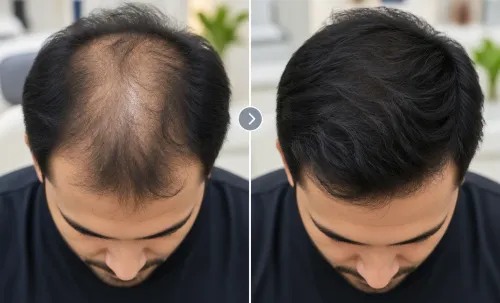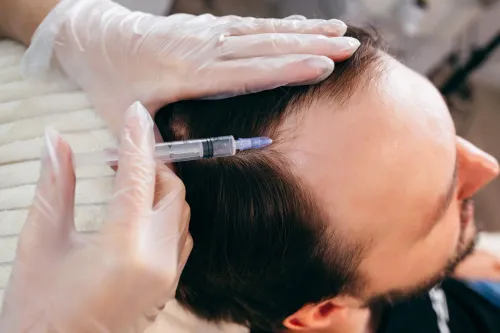

One of the biggest mistakes people make with hair loss is waiting until significant thinning develops before trying to understand the cause. Another is beginning random treatments as soon as shedding increases.
Choosing an appropriate Hair Loss Treatment requires knowing whether the problem is temporary shedding, progressive miniaturisation, a scalp disorder, localised loss, or established baldness.
For men and women in Nashik, Maharashtra, a structured assessment can help narrow the options and avoid spending months moving between unsuitable treatments.
Start With the Pattern You Can See
Different patterns provide useful clues.
Frontal recession may be associated with pattern hair loss, particularly when the temples gradually move backwards.
Crown thinning often develops gradually and can initially be more noticeable in photographs than in the mirror.
Diffuse thinning affects density across a wider area and can have several possible causes.
Sudden heavy shedding deserves attention because it may follow illness, major stress, nutritional changes, medications, or other triggers.
Defined patches represent another pattern requiring appropriate diagnosis.
Recognising the pattern is only the starting point. Clinical assessment determines what it means.
Check How Quickly Things Are Changing
Compare photographs taken six to twelve months apart.
If the hairline has clearly moved, the crown is increasingly visible, or overall density has declined, the condition may be progressing.
For people with longer hair, a reduction in ponytail circumference can also make diffuse density changes noticeable.
Review Possible Contributing Factors
Hair loss does not occur in isolation from general health.
A clinician may ask about:
- Recent illness
- Significant weight changes
- Dietary patterns
- Family history
- Medications
- Stressful events
- Pregnancy and postpartum changes
- Menstrual history where relevant
- Previous hair procedures
- Scalp itching, scaling, or inflammation
These details can help determine whether additional investigation is necessary.
Match Treatment to the Actual Problem
Once the condition is identified, treatment options can be considered according to their purpose.
Some patients may require medical management. Others may be candidates for procedure-based non-surgical treatment. People with established permanent baldness and suitable donor hair may eventually consider transplantation.
These approaches should not be treated as interchangeable.
A treatment intended to support existing follicles cannot simply replace missing follicles in every case. Similarly, transplantation does not automatically address the continuing loss of surrounding non-transplanted hair.
Look for These Signs During Provider Selection
A useful hair-loss consultation should involve more than quickly recommending a package.
Look for an assessment that discusses:
- The likely diagnosis
- Current stage of hair loss
- Expected progression
- Suitable treatment options
- Limitations of each approach
- Possible adverse effects
- How progress will be measured
- When reassessment will occur
Be cautious when every patient appears to receive the same treatment regardless of the pattern of hair loss.
Build a Long-Term Strategy
Dr. Vinay Chouksey at Jata Hair Sciences provides hair restoration assessment across surgical and non-surgical approaches. For people with progressive thinning, this broader perspective can help determine what type of intervention may fit the current stage.
The right Hair Loss Treatment in Nashik is not necessarily the newest procedure or the treatment with the most dramatic advertising. It is the approach that corresponds to the diagnosed cause, current follicular condition, medical suitability, and realistic objectives.
Early assessment can also provide a baseline for future comparison. When treatment decisions are based on documented progression rather than guesswork, patients can evaluate changes more objectively and adapt their hair restoration plan when necessary.
Keywords