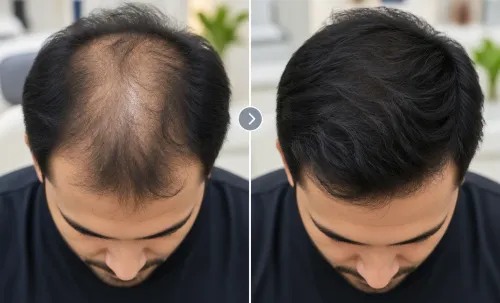

A receding hairline and thinning crown are two of the most common patterns that lead people to search for hair loss treatment. Although both can occur as part of hereditary hair loss, the extent, speed of progression, age of onset, and remaining follicle density can differ considerably between patients.
For this reason, choosing treatment simply by looking at advertisements or before-and-after photographs can be misleading.
At Jata Hair Sciences, Dr. Vinay Chouksey evaluates the pattern and severity of hair loss before discussing suitable management options.
Early Signs Should Not Be Ignored
Pattern hair loss often develops gradually.
Common early changes include:
- Hairline recession around the temples
- Reduced density behind the frontal hairline
- Increasing crown visibility
- Thinner hair strands
- Greater scalp visibility under bright light
- Difficulty maintaining previous hairstyles
Recognising these changes does not mean that everyone requires immediate treatment. It does mean that an assessment can help establish whether the loss is progressive.
Avoid Treating Every Hair Fall the Same Way
Increased hair shedding and patterned thinning are not necessarily the same problem.
Someone who suddenly notices hair fall after illness, stress, dietary change, or another trigger may require a different evaluation from a person whose temples have gradually receded over several years.
Scalp conditions and other medical factors can also influence hair quality.
Diagnosis should therefore come before treatment selection.
Treatments Depend on the Stage of Loss
Hair-loss management can include several categories of treatment depending on individual suitability.
These may include:
- Medical management
- Scalp-based treatments
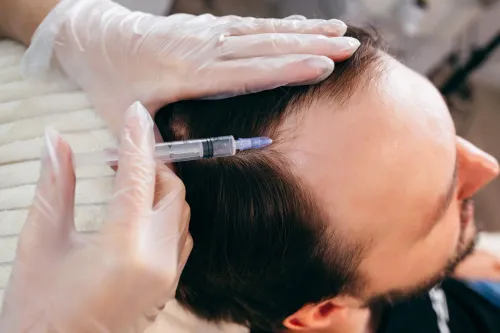
- Injectable therapies
- Regenerative procedures
- Hair transplantation
- Combination treatment plans
The presence of existing follicles is particularly important when considering non-surgical approaches.
Hair transplantation becomes a separate consideration when additional coverage is required and suitable donor follicles are available.
Why Donor Hair Matters
Patients with progressive hair loss should understand their donor area even if they are not currently planning transplantation.
Donor follicles are a limited resource.
If a transplant is considered in the future, the surgeon needs to plan not just for today's hair loss but also for possible progression.
An excessively low hairline or unnecessary graft use at an early stage may reduce flexibility later.
Mistakes That Can Delay Effective Management
A few common mistakes include:
- Changing treatments too frequently
- Using several products simultaneously
- Relying only on supplements
- Ignoring persistent scalp problems
- Waiting until hair loss becomes extensive
- Choosing treatment without knowing the diagnosis
- Assuming results from another patient will be identical
Hair growth takes time, so consistency and realistic monitoring matter.
Hair Loss Treatment
People searching for hair loss treatment in Nashik now have access to a wide range of medicines, procedures, supplements, and cosmetic solutions.
More options can also create more confusion.
At Jata Hair Sciences, Dr. Vinay Chouksey assesses the patient's hairline, crown, overall density, scalp, treatment history, and donor region where relevant.
A useful consultation should help the patient understand what type of hair loss appears to be present, which areas are most affected, what can realistically be improved, and how future progression may influence the plan.
The most appropriate treatment is not necessarily the newest procedure. It is the option that matches the diagnosis, stage of loss, and long-term hair restoration goals.
Keywords