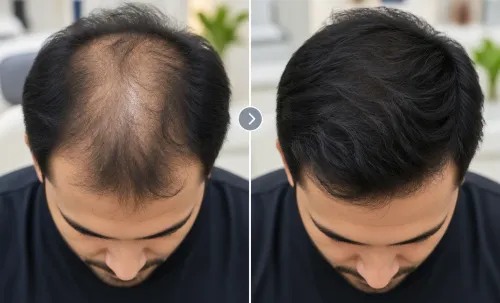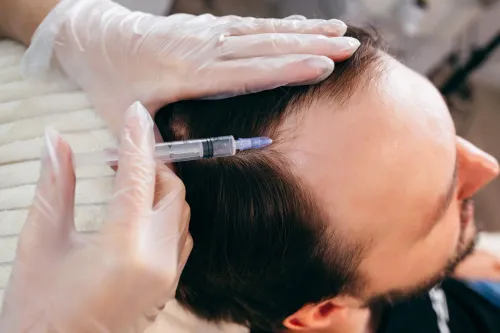

People experiencing early hair thinning increasingly come across regenerative hair treatments while exploring alternatives to conventional hair loss management. Autologous micrograft treatment is one such approach that uses biological material obtained from the patient's own body.
The treatment belongs to a different category from hair transplantation and should be considered only after understanding the cause and stage of hair loss.
At Jata Hair Sciences, Dr. Vinay Chouksey evaluates hair-loss patterns before recommending regenerative, medical, or surgical hair restoration approaches.
Understanding Autologous Micrografts
The term autologous means that material used during treatment comes from the same patient.
In micrograft-based procedures, a small tissue sample is collected and processed using a specialised system. The resulting preparation is then applied to selected areas of the scalp according to the treatment protocol.
Different technologies may use different processing methods, so patients should understand exactly what type of procedure is being recommended.
Why Diagnosis Comes Before Regeneration
Not every person noticing hair fall has the same condition.
Hair loss may appear as:
- Gradual frontal recession
- Crown thinning
- Reduced overall density
- Sudden increased shedding
- Patchy loss
- Hair breakage
- Scalp-related thinning
These patterns can have different causes.
A regenerative procedure may be discussed for selected patients with existing follicles, but it should not be used as a substitute for understanding why those follicles are becoming weaker.
Micrograft Treatment Is Not a Hair Transplant
This distinction is important.
Hair transplantation involves physically moving healthy follicles from a donor region to an area with reduced coverage.
Autologous micrograft treatment does not relocate follicles in the same way. It is generally discussed as a regenerative approach intended to support the scalp and existing follicular environment.
Someone with early thinning therefore has a very different treatment requirement from a person with an extensively bald area.
What Should Be Evaluated Before Treatment
A detailed hair assessment may include:
- Duration of hair loss
- Speed of progression
- Family history
- Existing density
- Hair shaft quality
- Scalp health
- Previous treatments
- Relevant medical history
Standardised photographs can also help document changes over time.
Patients should know what outcome the doctor is trying to achieve and how progress will be evaluated.
Questions Worth Asking
Before undergoing an autologous micrograft procedure, ask:
- What exactly does the procedure involve?
- Why is it suitable for my hair-loss pattern?
- What limitations should I understand?
- How many sessions may be recommended?
- When should treatment response be evaluated?
- What other treatments may be appropriate?
Clear answers make it easier to distinguish an individual treatment plan from a generic regenerative package.
Autologous Micrograft Treatment
The growing interest in regenerative aesthetics has made autologous micrograft treatment in Mumbai more visible among people researching early hair-loss solutions.
However, newer treatment terminology should never replace proper diagnosis.
At Jata Hair Sciences, Dr. Vinay Chouksey considers the condition of existing hair, stage of thinning, treatment history, and long-term restoration goals before recommending an approach.
Patients should also maintain realistic expectations. Regenerative treatments cannot be assumed to restore unlimited density or recreate follicles in every advanced bald area.
The most useful way to evaluate autologous micrograft treatment is to understand exactly what hair-loss problem is being treated and whether existing follicles are likely to benefit from a non-surgical regenerative strategy.
Keywords