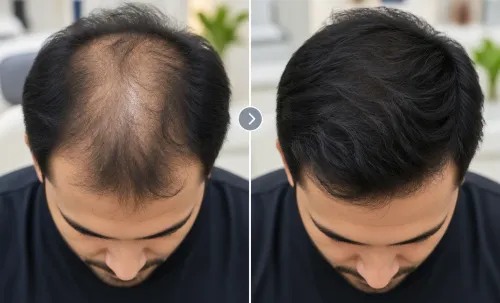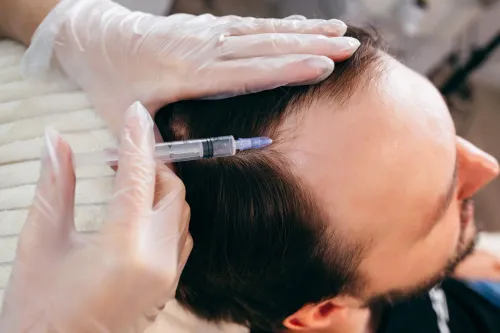

Persistent hair fall combined with reduced density can lead many people to explore non-surgical clinic-based treatments. One increasingly discussed option is GFC treatment, which uses a preparation derived from the patient's own blood.
GFC is generally considered in selected hair-loss cases where existing follicles are still present.
At Jata Hair Sciences, Dr. Vinay Chouksey evaluates the pattern of hair loss, scalp condition, existing density, previous treatment, and clinical history before recommending a suitable approach.
What Is GFC Treatment
GFC refers to Growth Factor Concentrate.
The process involves collecting a patient's blood and processing it according to the treatment system to obtain a concentrated preparation used during the procedure.
Although the treatment is blood-derived, patients should still understand exactly what protocol the clinic uses and why it has been recommended.
Hair Fall and Hair Loss Are Not Always the Same
Patients commonly use the terms hair fall and hair loss interchangeably.
However, increased shedding does not necessarily mean permanent follicular loss.
Temporary shedding can occur for different reasons, while hereditary pattern hair loss involves progressive changes in susceptible follicles.
A proper consultation should therefore identify whether the concern is:
- Excessive shedding
- Progressive thinning
- Reduced shaft thickness
- Patterned recession
- Crown loss
- A scalp condition
- Another form of alopecia
The diagnosis influences whether GFC has an appropriate role.
Who May Be Considered for Treatment
The presence and condition of existing follicles are important.
Patients with early or moderate thinning may have a different treatment opportunity from those with extensive long-standing baldness.
The doctor may review:
- Duration of thinning
- Pattern of loss
- Family history
- Existing density
- Scalp health
- Previous treatment response
- Relevant medicines
- Medical conditions
This information helps create a more individualised plan.
What Should You Expect From GFC
Patients should approach treatment with realistic expectations.
Hair growth takes time, and visible improvement is not usually assessed immediately.
The treatment schedule can vary depending on the patient's condition and the protocol being used.
Progress may be documented through photographs taken under similar conditions.
It is also important to understand that a non-surgical treatment cannot automatically provide transplant-like coverage in every advanced bald area.
Questions to Ask Before Starting
A consultation should answer questions such as:
- What type of hair loss is present?
- Why is GFC recommended?
- What is the treatment schedule?
- When should improvement be assessed?
- What limitations apply?
- Are additional treatments required?
- What happens if hair loss continues?
These discussions help patients understand whether the treatment fits their actual concern.
GFC Treatment
People looking for GFC treatment in Mumbai may see significant differences in clinic packages, session numbers, and marketing claims.
Choosing treatment according to price alone may overlook the most important factor, which is whether the procedure is appropriate for the hair-loss pattern.
At Jata Hair Sciences, Dr. Vinay Chouksey evaluates both current thinning and possible future progression before recommending hair restoration.
The goal should be a structured plan rather than an isolated procedure.
For suitable patients, GFC may be considered as part of non-surgical hair-loss management. The decision becomes more meaningful when patients clearly understand their diagnosis, expected outcome, treatment schedule, and how progress will be monitored over time.
Keywords